

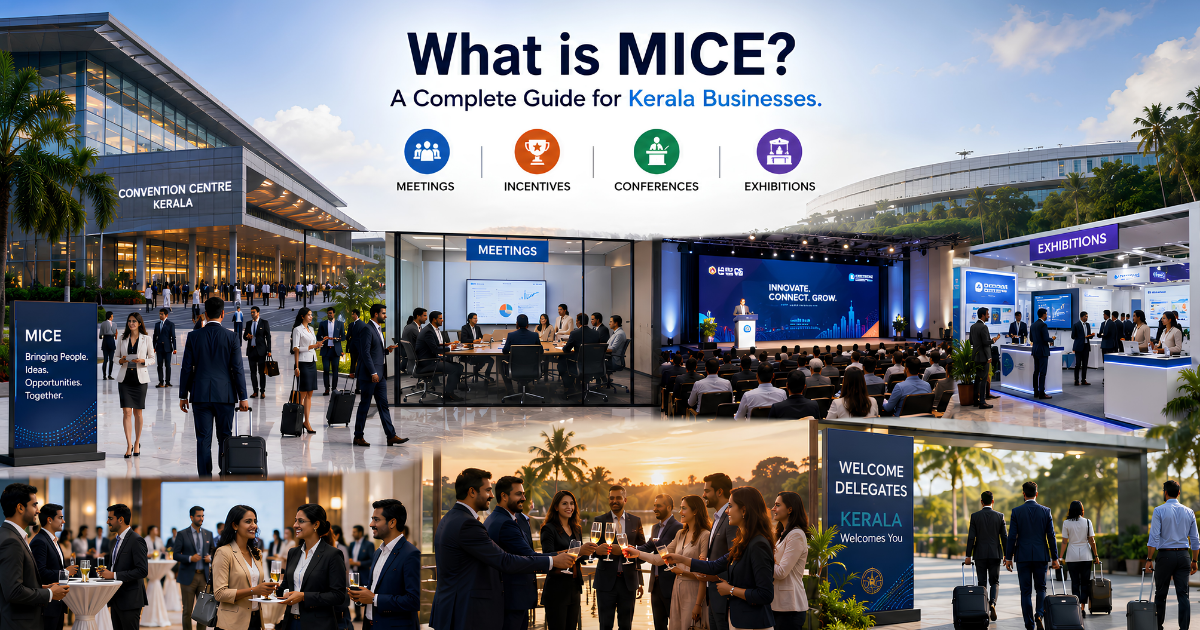
What is MICE? A Complete Guide for Kerala Businesses
If you have ever organised a company conference, an industry seminar, or a team recognition trip, you have already experienced MICE — whether or not you knew it by that name. MICE is the global term for professionally managed business events, and it represents one of the fastest-growing segments of the Indian events industry.
This guide explains what MICE means, how each of its four components works, why it matters for Indian businesses today, and what to look for when choosing a MICE event management partner.
Table of Contents
What Does MICE Stand For?
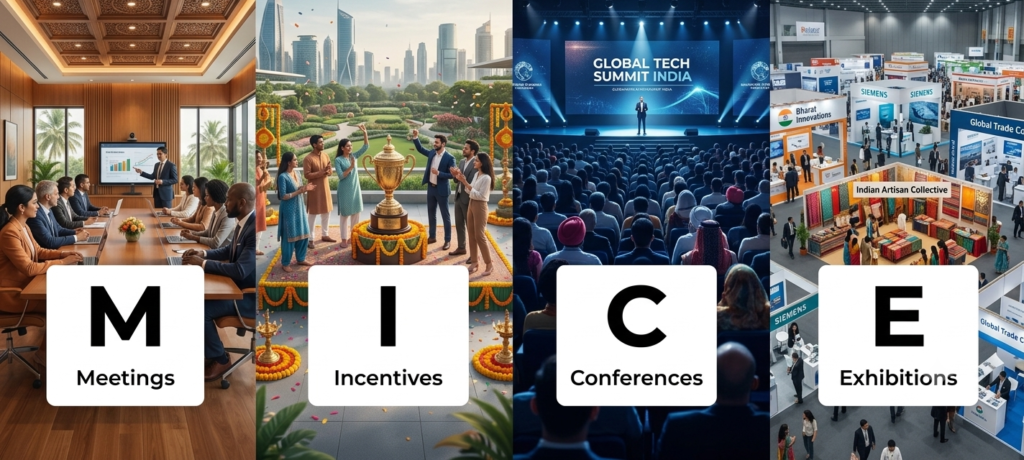
MICE is an acronym for Meetings, Incentives, Conferences, and Exhibitions. Each component represents a distinct category of business event — with its own planning requirements, audience, and objectives. Together, they form the backbone of how Indian organisations communicate internally, motivate their teams, exchange knowledge, and engage with trade audiences.
The term originated in the global hospitality and events industry and is now widely used by event planners, hotels, convention centres, airlines, and destination management companies worldwide. In India, the MICE sector has grown significantly over the past decade, driven by the expansion of corporate India, the growth of professional associations, and the rise of the pharmaceutical, banking, and information technology sectors.
M — Meetings
In the MICE context, meetings refer to professionally organised gatherings with defined business objectives. They are distinct from ad hoc internal calls or casual discussions — MICE meetings involve structured agendas, professional venues, formal facilitation, and measurable outcomes.
Common types of MICE meetings include:
- Annual General Meetings (AGMs) and Extraordinary General Meetings (EGMs)
- Board meetings and committee meetings
- Leadership conclaves and strategy off-sites
- Regional and national manager meets
- Town halls and all-hands meetings for large organisations
- Training and induction sessions
Meetings in the MICE sense are typically managed by a professional event company that handles the venue, audio-visual setup, delegate registration, catering, accommodation, and on-day coordination — allowing the client organisation to focus entirely on the content and outcomes of the meeting rather than the logistics.
I — Incentives
Incentive programmes are performance-based reward experiences — travel or event-based rewards given to employees, sales teams, or channel partners who achieve specific targets. Unlike meetings or conferences, incentive programmes are not about knowledge sharing or decision-making. They are about recognition, motivation, and building loyalty.
Incentive programmes commonly take the form of:
- Domestic group trips — Kerala backwaters, Goa, Rajasthan, Himachal Pradesh
- International group travel — Southeast Asia, Europe, the Middle East, and beyond
- Gala recognition dinners and awards ceremonies
- Experiential group activities — adventure camps, cultural tours, team-building retreats
A well-designed incentive programme does more than reward achievement — it creates shared memories, reinforces company culture, and signals to the broader team that performance is genuinely valued. Professional MICE companies handle everything from itinerary design and group bookings to on-trip coordination and formal recognition ceremonies.
Well-executed incentive programmes have consistently been shown to outperform cash bonuses in motivating long-term performance — the experience is remembered long after the bonus has been spent.
C — Conferences
Conferences are large-format gatherings that bring professionals together around a shared theme, discipline, or industry for the purpose of learning, networking, and knowledge exchange. They range from focused single-day seminars to multi-day national or international conventions with thousands of delegates.
Conferences in the Indian MICE context include:
- Industry and trade association annual conferences
- Medical and scientific conferences — including CME (Continuing Medical Education) programmes
- Academic and research symposiums and convocations
- Banking and financial sector conclaves
- Government and policy conferences
- Corporate all-hands and national sales conferences
Conference management is among the most complex of all MICE event types. A professional conference management company handles venue contracting, speaker coordination, abstract and scientific programme management, delegate registration, sponsorship management, exhibition floors, audio-visual production, and post-conference documentation.
Conferences are also significant business events from a revenue standpoint — sponsorship income, delegate registration fees, exhibition booth sales, and hospitality packages can collectively make a well-run conference a self-sustaining or even profit-generating event for the organising body.
E — Exhibitions
Exhibitions — also called trade shows, expos, or trade fairs — are large-format events where companies, organisations, and individuals showcase products, services, and innovations to a trade or consumer audience. They serve as powerful platforms for lead generation, product launches, and direct buyer engagement.
Exhibitions in the Indian MICE context include:
- Trade exhibitions and B2B expos for specific industry sectors
- Product launches with exhibition components
- Brand experience zones at conferences and conventions
- Road shows and activation campaigns across multiple cities
Professional MICE companies support exhibitors with booth design and build, logistics, delegate engagement planning, lead capture systems, and post-exhibition reporting. For organising bodies, MICE companies manage the full exhibition floor — exhibitor coordination, floor plan management, visitor registration, and on-site operations.
Why MICE Matters for Indian Businesses
MICE events are not a luxury — they are a strategic business tool. Here is why they matter for organisations across sectors:
1. They drive alignment and decision-making
Large organisations cannot operate on emails and calls alone. Leadership conclaves, strategy off-sites, and national manager meets are how senior teams align on direction, resolve disagreements, and build shared commitment to organisational goals. Done well, a single well-executed annual leadership meeting can set the productive direction of an entire organisation for twelve months.
2. They build culture and motivation
Recognition programmes and incentive trips are among the highest-impact tools available to HR and sales leadership. They signal what the organisation values, celebrate achievement publicly, and create the kind of shared experience that builds team cohesion far more effectively than any policy document.
3. They establish credibility and authority
For professional associations, medical bodies, and trade organisations, the annual conference is often the single most visible expression of the organisation’s standing in its field. A professionally produced conference — with quality speakers, smooth logistics, and a high-quality delegate experience — signals authority, seriousness, and institutional credibility.
4. They generate revenue
For many associations and organising bodies, MICE events are significant revenue generators. Sponsorship income, exhibition booth sales, delegate registration fees, and pre-conference workshop fees can collectively produce income that funds the organising body’s activities for the year.
5. They are more cost-effective when professionally managed
This surprises many first-time corporate buyers: professional MICE management often costs less than self-management. Event companies bring established vendor relationships, negotiated rates with hotels and AV companies, and the operational experience to prevent costly mistakes. The all-in cost of internal coordination — staff time, procurement errors, and on-day crises — frequently exceeds the professional management fee.
MICE vs General Event Management — What is the Difference?
This is one of the most common questions we hear from corporate buyers, and it is an important one. General event management companies typically specialise in social events — weddings, birthday parties, concerts, and celebrity appearances. MICE event management is a distinct professional discipline with different skills, different vendor relationships, and different standards of execution.
Here is how they differ:
- Protocol and corporate compliance: MICE events involving senior officials, regulators, or government representatives require specific protocol standards. MICE companies are experienced in managing these requirements; social event companies typically are not.
- Technical production: A conference with simultaneous interpretation, parallel tracks, live streaming, and an exhibition floor requires specialist AV and production expertise that goes well beyond what most social event companies can deliver.
- Vendor relationships: MICE companies maintain established relationships with hotel properties, convention centres, AV companies, translation services, and logistics vendors — relationships that translate into better rates and higher service reliability.
- Post-event accountability: Corporate events require post-event documentation, attendance reports, budget reconciliations, and sometimes statutory records. MICE companies build this into their standard deliverable.
- Understanding of institutional dynamics: Banking events involve RBI compliance considerations. Medical conferences have NMC accreditation requirements. AGMs have Companies Act obligations. MICE companies understand these institutional contexts; general event companies do not.
How to Choose a MICE Event Management Partner in India
Not all event management companies that describe themselves as MICE specialists have the depth of experience the label implies. Here are the key questions to ask before appointing a MICE partner:
1. What is their sector experience?
Ask specifically about events in your sector — medical, banking, association, corporate. The dynamics of a pharmaceutical CME are fundamentally different from a banking conclave or a university convocation. Look for demonstrable experience in your specific event type.
2. Who manages the event on the day?
This is the most important operational question. Many event companies sell the account at the senior level and hand off execution to junior staff. Ask whether the person managing your planning process will be on-site on event day.
3. What does their proposal include?
A credible MICE company provides a consolidated proposal covering all services and vendor costs — not a fragmented list of individual vendor quotes that leaves budget gaps and accountability voids. The proposal should include a clear payment schedule, a run-of-show template, and a post-event deliverable list.
4. Are they formally recognised?
Recognition under Startup India (DPIIT), registration with state startup missions like Kerala startup mission, and membership of industry bodies are all markers of a company that operates with structured governance.
5. What happens when things go wrong?
Ask about backup plans — what happens if the primary venue cancels, a key vendor fails, or a speaker drops out at the last minute. A professional MICE company has contingency plans built into every event.
Conclusion
MICE — Meetings, Incentives, Conferences, and Exhibitions — is not just an industry term. It is a framework for understanding how professionally managed business events create organisational value: aligning leadership, motivating teams, building knowledge communities, and establishing institutional credibility.
For Indian organisations navigating the increasing complexity of corporate, institutional, and association events, a professional MICE partner is not a discretionary spend. It is a strategic investment in outcomes.
